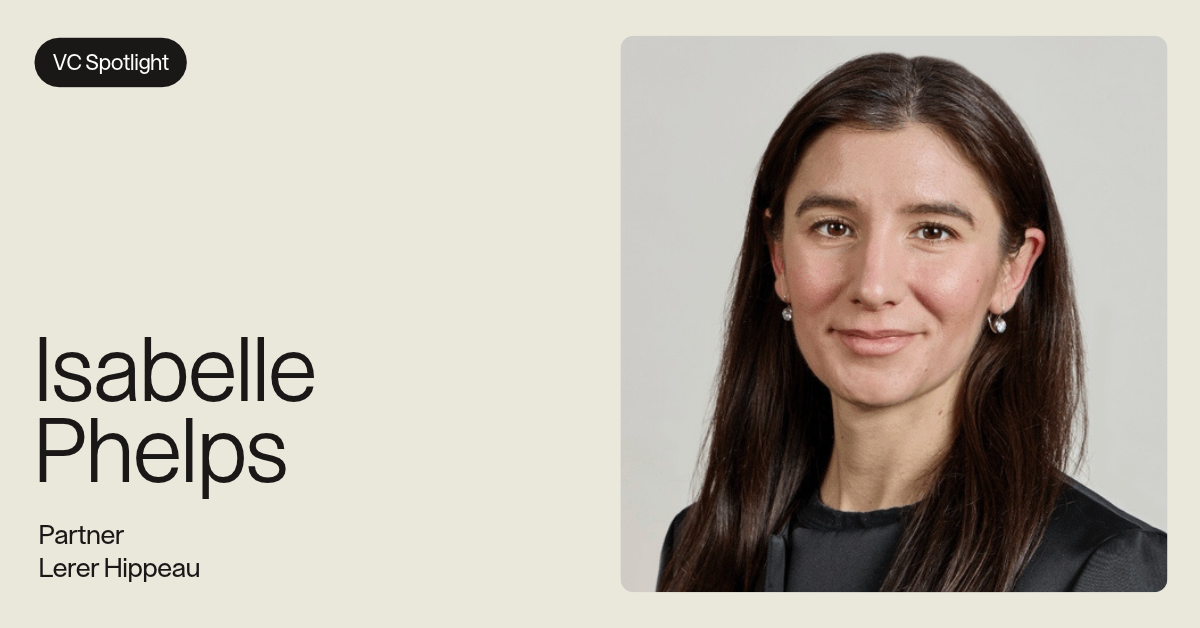
VC Spotlight: Isabelle Phelps, Partner, Lerer Hippeau
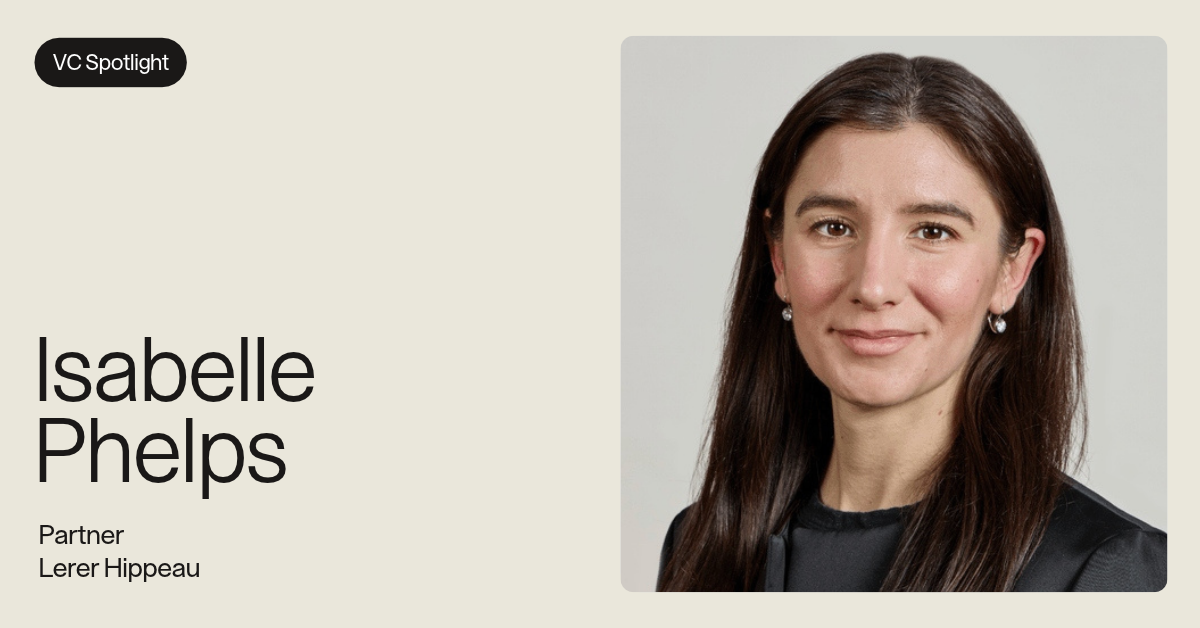
Isabelle Phelps took a bet on New York. Now, she’s in for the long haul.
Brainstorming strategies and pitches with startups around MIT, where she earned her MBA, her heart grew for founders in the early stages.
“Once we back our founders, our aim is to stay in their corner for the long haul,” Isabelle told us.
It was not long before Lerer Hippeau offered Isabelle, a then-partner at Dorm Room Fund, a summer associate position.
From there she became an even closer friend to the early-stage founder, with New York as a magnet for ambition and creativity with a “large base of operators who have successfully scaled companies here.”
Moving to New York after business school was “a bet on the burgeoning strength of the New York early-stage tech ecosystem,” Isabelle said. “It’s been incredible to see how much it’s grown in that time.”
Based on her experience as an operator, and working with a team focused on “finding founders before they’re famous,” she predicts the startups most likely to boom will run more like services companies than software companies.
And she expects a great deal of those companies to come out of New York.
We caught up with Isabelle to chat about where she started, what advantages she sees for founders and investors here in New York, some common pitfalls in the pitching process, the tech that excites her the most, and much more
–
Where did your career start?
Isabelle: I started on the operating side, working in both marketing strategy and business planning and operations out of undergrad. It wasn’t until starting business school at MIT that I started investing. Given my operating experience, I was quickly pulled into helping startups across the MIT ecosystem — helping them think through their go-to-market strategy, their product positioning, helping to make hiring introductions — and that naturally transitioned to investing into those businesses, first as a Partner at Dorm Room Fund and later as a Summer Associate at Lerer Hippeau.
Lerer Hippeau was a natural fit, given I knew early on that I wanted to invest at the early stage and also wanted to be in New York. I was lucky to get a full-time offer after my first summer, joined as an Associate when I graduated, and am now a Partner on the team.
What stage do you typically invest at and what’s your average check size?
Lerer Hippeau is an early-stage fund, investing across pre-seed and seed stage rounds. We’re comfortable doing inception-stage bets into founders we love, but we can also lead larger seed rounds. Regardless, we’re typically making a substantial investment as a lead or co-lead, with the capital to continue to support companies over time. Once we back our founders, our aim is to stay in their corner for the long haul.
You’ve been involved with investments in companies like Augmodo, Air, and Valdera. Can you walk us through one investment where you recognized an opportunity that wasn’t immediately obvious to others? What ultimately convinced you to make the bet?
We’re a generalist fund backing founders we believe are exceptional across many different categories, which is reflected here in this short list. Overall, we index around founders, but alongside that I personally tend to think a lot about business models, data network effects, and other compounding points of advantage for a business. The companies listed here illustrate that, as each are systems of record and data engines for large, fragmented industries.
When those companies work, they’re obviously good businesses, but they don’t always look obvious to start. Augmodo is a great example. On the surface it looks like a wearable for store associates, and the combination of hardware, retail, and deep tech required made a lot of investors nervous at the start. However, the CEO and Founder, Ross Finman, is exceptionally well-suited to build the business and we believed in his vision to build the data engine for the 80% of the global workforce that doesn’t work behind a screen.
My colleague Will and I led Augmodo’s seed round in 2024 to build the canonical dataset for physical work and physical AI assistants. Every shift, an associate wearing the Smartbadge helps build a live 3D map of the store and what’s on the shelf. The more sites Augmodo is in, the better its models get, and the more valuable that data becomes to retailers and the brands selling through them. Today over a petabyte of data runs through the platform daily.
Lerer Hippeau has deep roots in New York’s startup ecosystem. What advantages does NYC offer founders today, and how has the city’s position in the broader venture landscape changed since you started investing?
New York’s biggest advantage is its proximity to the industries that create value out of technological advancement, particularly at the application layer. Finance, healthcare, media, retail, real estate, insurance: the buyers, the operators, and the domain experts of all of those industries are here. It’s also always been an incredible magnet for ambitious and creative talent, the kind we think AI will empower. It has the largest inflows of technical talent and is the number one destination for Ivy League graduates. And the success of its tech ecosystem has also embedded a large base of experienced operators who have scaled companies here.
I’d spent time in San Francisco earlier in my career, and when I decided to move to New York post-business school it was a bet on the burgeoning strength of the New York early-stage tech ecosystem. It’s been incredible to see how much it's grown in that time.
Looking ahead five years, what’s one prediction you have about the startup or venture capital landscape that might surprise people?
It’s been well-covered in venture circles, but for those not as close to it, I think they’ll be surprised that some of the biggest companies of the next five years will look more like services businesses than software companies. For a long time, venture steered clear of services because of the margins, and AI changes that math: instead of selling a tool and hoping the customer adopts it, a small team can now deliver the outcome itself, whether that’s doing the accounting, collecting the receivables, or automating the factory line. With its depth in professional services, I expect New York to produce a lot of these companies.
What’s the most common mistake you see founders make when pitching to investors?
Founders today spend more time than ever talking about (and manufacturing) traction and early momentum. In a fast-moving market, that’s important, but we’re more interested in hearing about you — the founder — your vision, and why you win in the long-term. It’s great to have the opportunity to invest in a company that has demand on day one, but, in today’s consensus-filled market, I'm even more interested in the opportunities that the market hasn’t woken up to yet.
What’s an investment from the last 12 months you’re especially excited about?
We’ve been very active over the past 12 months, but the most recent investment we’ve announced publicly is Type. There's no shortage of AI assistants — the list gets longer by the day — but we still think there is a gap in the enterprise market. Nearly all of the agents in the market excel at helping one person get more done. But work is a group activity. Type is a shared “multiplayer” workspace where a whole team can work with AI together, through chats, docs, integrations, and AI teammates everyone can see and build on, whether in Slack or Type's desktop and mobile apps. Instead of 40 siloed team members each teaching a model the same things about your business, the context, learnings, and work compound in one place. Becoming not only the place to do work, but also the knowledge graph and context layer that helps your business grow better over time.
Cofounders Fletcher, Alex, and Komran have spent their careers building collaborative tools for teams; Fletcher and Komran cofounded Halp, which was backed by Slack and later acquired by Atlassian. They understand how teams actually function, and they have an exciting vision for how future teams will work with AI.
What’s in your tech stack? What’s your favorite AI tool?
We use Granola for meeting notes, Affinity as our CRM, Harmonic for company and market data, and run our workflows through Claude. However, we’re finding that it's more important now than ever before to be able to own our data, and so we’re building out our own data warehouse and tech stack internally.
What are some of the top resources you recommend for founders starting out?
There is so much publicly available information about how to build a company and raise capital now. What I don’t think anyone can replicate – and where I think the beauty and insight really lies — is in speaking with your future customers and speaking with founders one or two years ahead of you. They won't have the answers for you and your business, but those conversations will help you get a better sense of what and how you want to build.
Rapid fire: You have a founder or LP from out of town. Where are you taking them?
A recent favorite has been breakfast at King — it’s quiet, simple but delicious, and a good excuse to sit outside while the weather is still nice!
What’s the best slice of pizza in NYC?
Truly any kind. It’s hands down my favorite comfort food.