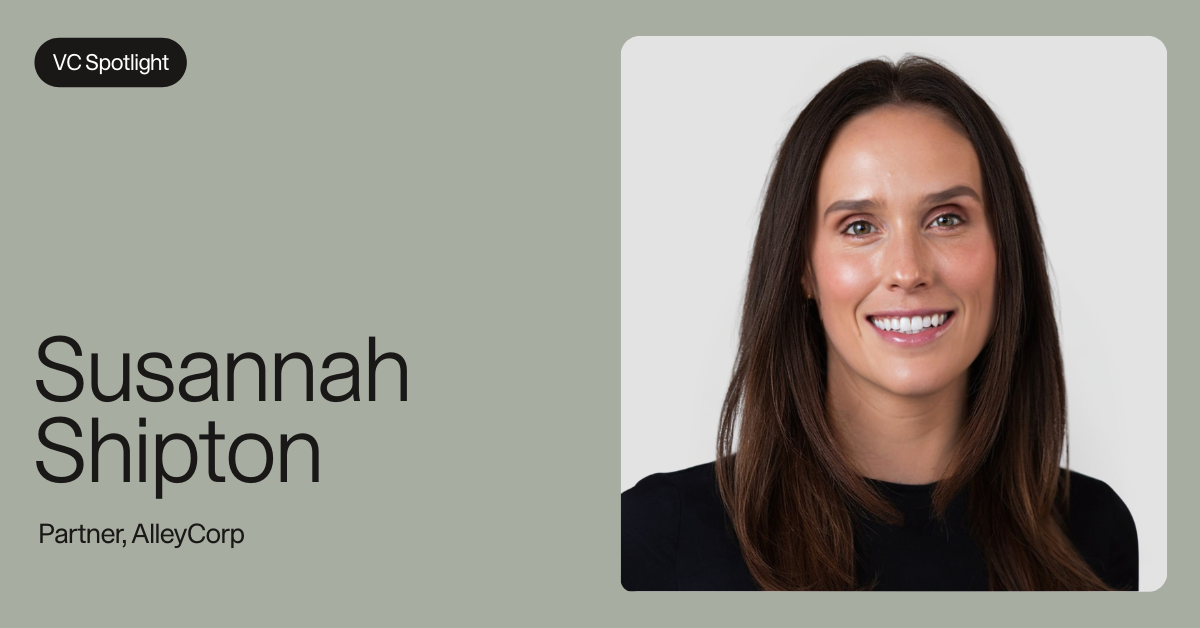
VC Spotlight: Susannah Shipton, Partner, AlleyCorp
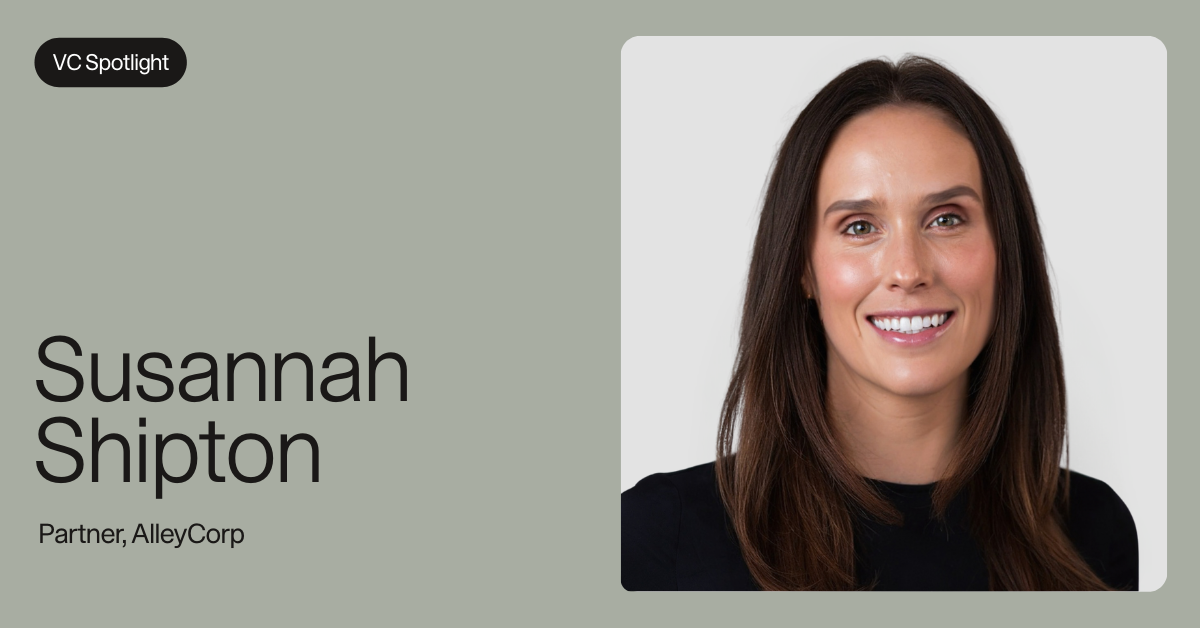
When Susannah Shipton joined AlleyCorp in 2019 working on the platform side, she had a straightforward question to answer: how do we find and spend time with the smartest and most ambitious people in New York?
Fast-forward a few years, and Susannah, now a Partner at AlleyCorp, has a similar task.
“At its core, this is the same thing I am solving for as a Partner on the investing side — a singular obsession with finding and backing the brightest and hungriest founders who are uniquely positioned to solve a problem,” she told us.
Today, as you’ll read in our interview below, Susannah takes that task a step further. When she’s deciding to invest in a B2B or consumer marketplace, in addition to doing due diligence on the founder and obvious metrics, she looks to the company’s customers.
“We do tons of customer references and I am looking for them to be absolutely glowing,” she said. “I need to hear that they or their business would not survive without the product, and I need to hear them talking about what features they want to be built next.”
We caught up with Susannah to discuss her career, how her years working in operations have shaped her investment philosophy, her tech stack, and much more.
–
Where did your career start?
Susannah: I started my career at Artsy, a venture back art marketplace based in New York. It was an incredible place to operate — super talent dense with an ambitious vision, and solving one of the trickiest consumer purchases! I chose to work there because in undergrad I’d majored in medieval history and art, and that was my obsession. Artsy was a place where brilliant people were expanding the art market and making it more accessible, which was something that meant a lot to me. I honestly had no idea where that path would lead!
You joined AlleyCorp in 2019, first leading platform efforts, and now as an investor — can you share a little bit about your journey at AlleyCorp and what led you to an investing role?
I joined AlleyCorp in 2019 when we were five people. While we called the role “Platform,” the question I was solving for was very simple: how do we find and spend time with the smartest and most ambitious people in New York? At its core, this is the same thing I am solving for as a Partner on the investing side — a singular obsession with finding and backing the brightest and hungriest founders who are uniquely positioned to solve a problem. So the evolution was actually very natural: given my interests, it was clear to me that the best way to deliver value to AlleyCorp was to chase and write checks to those founders directly. It’s the best job ever.
I have always been wary of the red tape that sits between platform and investing, and I was very fortunate that [AlleyCorp Founder and CEO] Kevin Ryan, [GP] Marshall Porter, and the team at AlleyCorp have a flexible and long term view about investing in people. I think Platform leaders are actually uniquely positioned to become investors and that we as an industry need to be more supportive of that.
What stage do you invest at and what’s your average check size?
I invest pre-seed through A, with an emphasis on backing companies in their earliest days. We will write checks between $1 million and $10 million.
How did your experience in strategy & operations at Artsy shape your investment philosophy at AlleyCorp?
At Artsy I was really fortunate to be in a seat (initially chief of staff) where I had an expansive, birds eye view of the company. My job was to add surface area to the leadership team and almost act like an internal consultant — working on new business lines, launching new processes, and embedding teams where necessary. I had the chance not only to test out many different parts of the business, but also to see the inner-workings of fundraising and the board.
The most helpful thing in becoming an investor has been that operating experience itself. While I have by no means solved every single type of problem a founder has faced, I’ve seen a lot of them or have worked alongside someone who has. I think it’s very helpful for an early stage investor to be able to put yourself in the shoes of your companies and have lived that experience to some extent.
You invest across B2B and consumer marketplaces, including creator economy companies. What patterns or signals do you look for that indicate a marketplace is poised for breakout success?
The thing I index most on outside of the founder and obvious metrics is the intensity of customer feedback about a product. We do tons of customer references and I am looking for them to be absolutely glowing. I need to hear that they or their business would not survive without the product, and I need to hear them talking about what features they want to be built next. One concrete way to measure this is marketplace cohort retention — how many of these users are coming back over time, and are they increasing their spend.
What’s the most common mistake you see founders make when pitching to investors?
I think the best “pitches” are much more like a conversation between two prepared minds. A lot of this actually falls on an investor — if an investor comes in completely cold they aren’t really holding up their half of the bargain. On the founder side, I love being able to review materials in advance (even if just a few sentences from the founder, or reading a few articles they shared) so that during the conversation a deck can be used in the background but is not necessarily the central focus. “Pitches” should really just be two parties meeting, learning, and deciding if they want to work together to tackle an exciting problem.
What's an investment from the last 12 months you’re especially excited about?
It’s still in stealth but I led the seed in a company in the tech safety space that is growing really fast. I am very excited for them.
What’s in your tech stack? What’s your favorite AI tool?
Wispr flow and Blockit are two current favorites. And building with Claude Code like everyone else! A super fun and useful adventure.
What are some of the top resources you recommend for founders starting out?
Getting other founders as advisors and early angels is incredibly helpful, and I also love it when people have early customers incentivized in the business as well.
Rapid fire: You have a founder or LP from out of town. Where are you taking them?
Kevin Ryan’s new restaurant, Oriana!
Choose one: power breakfast, power lunch, or work dinner. Where?
Power breakfast all day long. I love AbcV in Flatiron.
What's the best slice of pizza in NYC?
I love a sourdough slice, and usually head to Leo Sourdough in Williamsburg.