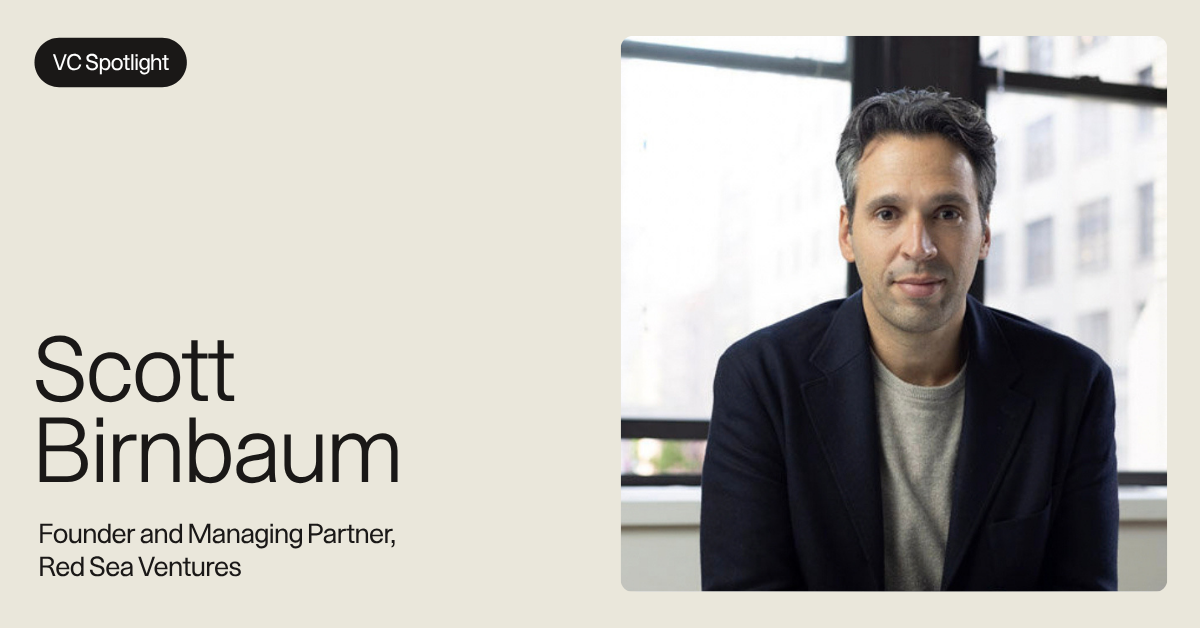
VC Spotlight: Scott Birnbaum, Founder and Managing Partner, Red Sea Ventures
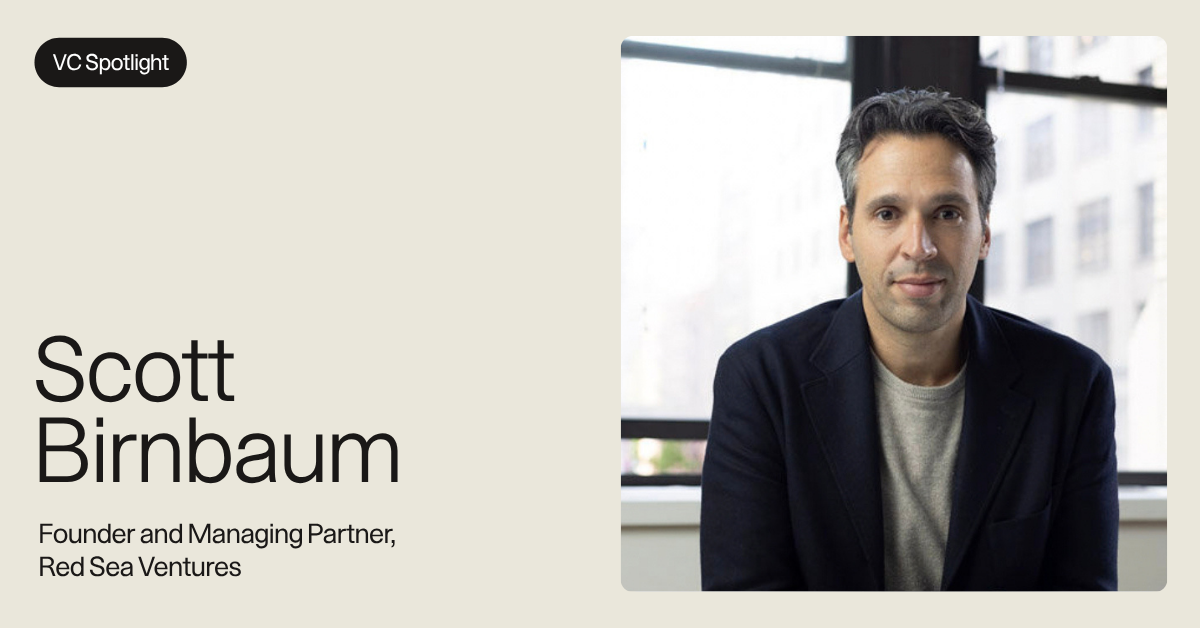
Scott Birnbaum, Founder and Managing Partner at Red Sea Ventures (and a Tech:NYC board member), first began building as a senior at Georgetown University in 1999. He founded Epok, a collaboration and data sharing platform for the intelligence and law enforcement communities.
As you’ll read in our interview below, that initial founder experience still shapes his work today.
“Running Epok for seven years, starting at 21, taught me about all the challenges a founder and business can face,” Scott told us. “Today, when I’m sitting across from a founder I can feel in my gut when someone is building from a burning need versus building because they smelled an opportunity.”
This year, Red Sea Ventures is hosting its second annual Consumer Tech Summit, bringing together the players shaping the future of consumer digital. As for what that future looks like? Consider Scott bullish.
“We also think that we are headed into the golden age of consumer where both brands and consumer tech will massively benefit from the new stacks powering those industries from AI to molecule development and performance marketing,” he said.
We caught up with Scott to discuss his career, the consumer tech sector, the top resources he recommends for founders, and much more.
–
Where did your career start?
Scott: The first real thing I built was my senior year at Georgetown in 1999. When my co-founder and I started Epok, we were building early cloud infrastructure for information sharing and collaboration across networks, essentially a SharePoint extranet solution. We were selling it to law enforcement and intelligence agencies. The former Deputy Director of the NSA was on our board. The founding CTO of OpenWave, the company that built the mobile browser for the original mobile phones, joined as our CTO. We had a remarkable team for a couple of recent grads.
My co-founder and I ran Epok for almost seven years. That experience, being a founder at 21, no safety net, figuring it out in real time, that’s where my career actually started, and in many ways it’s the lens through which I see everything else I’ve done since. Law school, White & Case, CBS, those chapters each added something. But Epok is where I learned what it really means to build something from nothing.
You founded Red Sea Ventures in 2011 — what was the catalyst?
It wasn’t one single moment, it was a convergence. Throughout my career, I’d been angel investing and providing advice to startup founders. What that period confirmed was that I genuinely loved enabling founders and that nothing else I could do professionally excited me as much as this.
With a view on NY tech in 2013 and a belief that NYC would become one of the core powerhouses of startups globally, I launched Red Sea Ventures. The timing felt right on a structural level, what used to cost $5 million to build in 2001 when I started my first company cost a fraction of that a decade later. That meant a wave of first-time founders was coming who needed real support, not just a check from a fund that showed up for board meetings. There weren't many seed-focused funds in New York at the time, and that felt like a real opening.
What stage do you invest at and what's your average check size?
We focus on pre-seed and seed. In Fund IV, our average initial check is around $1 million, with the range sitting between $500k and $2 million depending on the deal. We reserve 50% of the fund for follow-ons because we believe in backing winners as they prove themselves.
We’re also targeting roughly 10% initial ownership — that’s up from about 2% in Fund I, and it reflects how much more conviction and capital we're bringing to each investment. We’ll lead, co-lead, or participate, we’re flexible, but we want to be a meaningful, active partner to our founders.
You’ve worked as a lawyer, operator, founder, and investor. Which of those experiences most shapes how you evaluate founders today?
Being a founder, without question, but the law trained a muscle that I use every single day. Running Epok for seven years, starting at 21, taught me about all the challenges a founder and business can face. Today, when I’m sitting across from a founder I can feel in my gut when someone is building from a burning need versus building because they smelled an opportunity.
The lawyer years sharpened my attention to detail and gave me a real window into complex transactions, M&A, project finance, which turns out to be invaluable when you’re coaching a founder through an M&A process, early design partnership or distribution deal, or a financing negotiation. But the founder experience is the one that grounds my empathy. I know what midnight looks like when the business isn’t working. That’s why I try to be the person founders can actually call and have a sympathetic partner to speak with that is going to be real but also solutions oriented.
You’re hosting RSV’s second annual Consumer Tech Summit. What conversations should the industry be having right now, and which trends are still being overlooked?
The conversation the industry outside of the AI native startups needs to have is about what AI actually does to the internal org chart. There is so much room for innovation and optimization but it sometimes requires a meaningful change to internal culture and operations. We also think that we are headed into the golden age of consumer where both brands and consumer tech will massively benefit from the new stacks powering those industries from AI to molecule development and performance marketing.
The overlooked trend I’d push hard on is the Consumer Packaged Goods (CPG) M&A cycle. I think people are still underestimating how aggressively the strategics are going to move. Poppi to PepsiCo for $2 billion, Gruns to Unilever for $1.2 billion, Rhode to e.l.f. for $1 billion, Siete to PepsiCo for $1.2 billion, those weren’t accidents. Legacy brands are losing shelf space and they know it. These businesses can be built more capital efficiently than ever preserving the equity of founders, teams, and early investors from dilution. The strategics are going to keep buying their way into the next generation of consumers.
And early-stage consumer VC is genuinely underfunded right now. Seed funding in consumer is down 21% year-over-year while late-stage is surging 83%. That gap is a real opportunity. We’re intentionally investing in that gap before the herd returns.
What’s the most common mistake you see founders make when pitching to investors?
Not building a sober capital plan and failing to recognize the capital efficiency that is possible today. We are seeing more companies being built with minimally sized teams leveraging AI to scale and pushing into distribution partnerships rather than pure performance marketing. Founders need to come to the table with a story about defensibility and unfair advantages to raise quality rounds.
What do the best founders you’ve worked with have in common before the rest of the market sees it?
A few things that consistently show up early: First is founder-market fit, not just domain expertise, but a kind of personal obsession with the problem. They’re not building because of an economic opportunity; they're building because they have no choice. Sweetgreen, Prose, Sundays for Dogs, in every case the founders had a deep, lived relationship with the problem they were solving.
Second is a really high intellectual ceiling combined with genuine humility. The best founders I’ve backed know exactly what they don’t know and they move fast to fill those gaps.
Third, and this is the one that’s hardest to articulate, is their capacity to build community around the product before the product is fully there. The startups that win in consumer aren’t just selling a product or service; they're giving customers an identity, something to belong to. You can see that magnetic pull starting very early if you know what you’re looking for.
And the fourth is just how they handle adversity. I try to understand their personal history with it — everyone who’s built something real has a moment where everything fell apart, and how they walked through that tells you almost everything.
What’s an investment from the last 12 months you’re especially excited about?
I’ll point to two that tell slightly different stories about where we’re headed. Granted Health, which we incubated with the thesis that AI can finally make medical billing error detection, negotiation, and resolution of medical costs accessible to people who can’t afford a team of specialists. That outcome validates the incubation model and shows that when you’re early enough and right about the category, the returns are asymmetric.
The other one I’d highlight is Range, our AI wealth management platform for the mass affluent, people with $1 to $10 million in net worth who’ve historically been underserved by the big banks. It’s a fast growing market of younger customers that aren’t interested in a traditional wealth management service and want real time answers to their questions.
What’s in your tech stack? What's your favorite AI tool?
We're working with Claude, ChatGPT, Google Workspace, Granola, LinkedIn, and more. The full modern knowledge-worker stack. For research, synthesis, drafting investment memos, preparing for founder meetings, internal operations, these tools have changed the leverage a small team can operate with and some other use cases we aren’t sharing publicly just yet.
At RSV we’re a boutique, we punch above our weight because we have to. AI lets us do the work of a team twice our size. I’m genuinely bullish on the founders building in the consumer AI application layer right now precisely because I’m living it as a user every day.
What are some of the top resources you recommend for founders starting out?
On the community side: Get into a room with other founders as fast as possible and build relationships with inspiring people to learn from them. Use X to listen to identify voices building in your category. Take the time to network with and meet investors who know your space and learn from their perspective and learn to speak VC.
The best resource is pattern matching from the founders who’ve done it, which is a big part of why we run our Founder Breakfast Series. We’ve had Nic Jammet on building community and brand at Sweetgreen, Jake Heller on navigating a $650 million acquisition, Joey Zwillinger on sustainability and building Allbirds. There’s no substitute for hearing someone who's been in it tell you exactly what they got wrong. This is also why we host our two Annual Summits: The Consumer Brands Summit in the fall and the Consumer Tech Summit — April 29 this year.
Rapid fire: You have a founder or LP from out of town. Where are you taking them?Either Cafe Cluny in the West Village or Chez Fifi on the Upper East Side — depends who I'm meeting and what time of day.
Best slice of pizza in NYC?
Fini Pizza — shout out to Sean Feeney!