VC Spotlight: Adrianna Samaniego, Partner, Cherryrock Capital
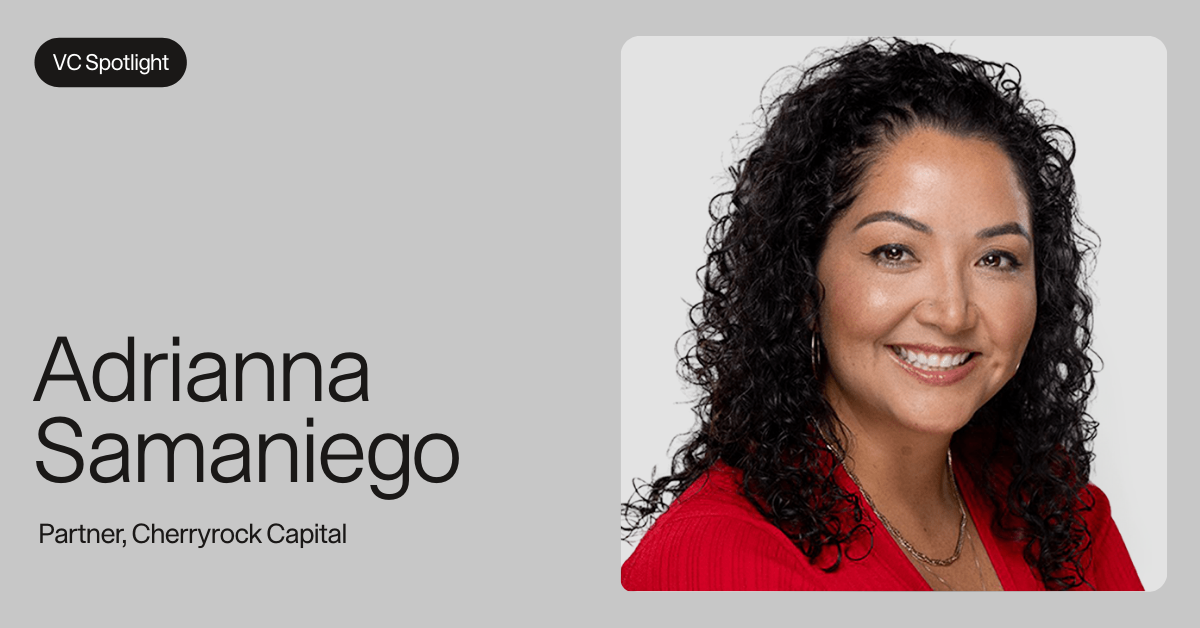
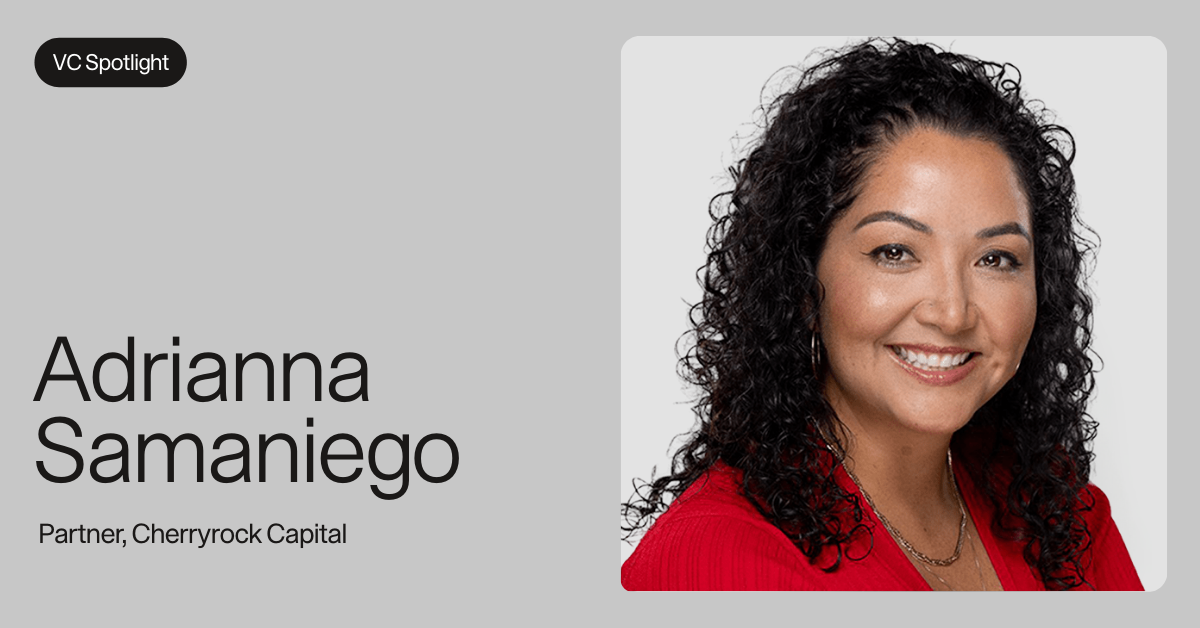
Technically, Adrianna Samaniego, Partner at Cherryrock Capital, started her career working on digital marketing and growth strategies at Google. But, as you’ll read in our interview below, her passion for building, entrepreneurship, and backing underserved visionary founders started long before that.
Adrianna comes from a family of small business owners, and by the time she was 12, she had already learned how to manage the books of her grandparents’ plumbing and construction business.
“I grew up watching my grandparents build a business the hard way, in systems that were not exactly designed to make things easy for them,” she told us. “That shaped how I see entrepreneurship and probably why I have always rooted for the underdog.”
Adrianna helped launch Cherryrock out of stealth in 2025 with a focus on those underdogs, and “a deep belief that talent is everywhere, even if capital and access are not.”
We caught up with Adrianna to discuss her career, how the industry can better unlock funding pathways for underinvested founders at scale, her tech stack, and much more.
–
Where did your career start?
Adrianna: Technically my career started at Google. My career probably started long before Google.
I come from a family of small business owners, and some of my earliest memories are helping my grandparents with their plumbing and construction business. By the time I was around 12, I was learning how to manage the books, organize invoices, and understand how money moved through a business. My grandmother taught me all of it. I loved it. That was really my first window into entrepreneurship and the discipline it takes to build something from the ground up.
My formal career started at Google, working on digital marketing and growth strategies for Fortune 500 companies. It was an incredible place to learn two things that still shape how I invest today: how to sell and how to operate at scale.
Selling is a surprisingly important skill in venture capital. As investors, we’re constantly selling our vision to founders when competing for deals, our strategy to LPs, and our conviction in markets that may not yet be obvious to others. During my seven years at Google I moved across sales, product marketing, and finance. I learned how to sell, how to operate at scale, and how to build inside a large system. But I always knew I was more of a builder first as an intrprenuer. After sales I created my own job description to focus at the intersection of business and inclusion, including launching supplier diversity initiatives that ultimately helped direct over $2 billion in procurement toward minority and women-owned businesses.
Eventually I left Google to become an entrepreneur myself. I received funding from Area 120, Alphabet’s incubator, to build a B2B procurement platform. That experience taught me firsthand how hard it is to build a company, find product market fit, and earn trust as a founder. It also clarified for me that I wanted to spend my career backing people doing exactly that.
You helped found Cherryrock Capital in 2024 — what was the catalyst?
[Cofounder] Stacy Brown-Philpot and I first met at Google and later reconnected around a shared set of values and a shared ambition. We were both raised by incredible mothers, both bootstrapped our way into the rooms we now sit in, and both have a deep belief that talent is everywhere, even if capital and access are not.
Stacy had a vision to build a new kind of venture firm, one designed to help change the face of wealth creation and become part of the foundation for the next generation of entrepreneurs. I was excited to join her and Saydeah Howard in helping bring that vision to life.
At the time I was investing earlier stage and seeing firsthand how difficult it was for many founders to reach Series A. The reality is that only a small fraction of seed companies make it there. Depending on the cohort, only about 30% of seed backed startups raise a Series A within two years, and in more recent markets that number has dropped closer to the mid teens.
When we looked at the landscape we saw a clear gap. There were many firms focused on seed, but none built to consistently lead Series A and B rounds for underinvested founders who had already demonstrated product market fit and were ready to scale.
That was the opportunity behind Cherryrock and what drew me to be part of the founding team. We came out of stealth in February 2025 with our $172 million Fund I, and today we lead Series A and B rounds backing founders who are audacious in their vision, authentic in how they build, and accountable to their metrics and stakeholders.
What stage do you invest at and what’s your average check size?
We lead at the Series A and Series B.
We run a disciplined, concentrated strategy and usually make four to five investments a year, which gives us the ability to partner deeply with founders as they scale. Our average check size ranges from about $5 million to $12 million, with roughly $6 million to $8 million at Series A and $8 million to $10 million at Series B.
We like to lead or co-lead and be long term partners to our founders.
You’ve helped build programs for Black, Latine, LGBTQ+, Indigenous, and women founders. What’s one thing the venture ecosystem still misunderstands about how talent and innovation actually show up?
The venture ecosystem still too often assumes that capital allocation reflects where talent is. It doesn’t.
I’ve always considered myself a builder, and I think a lot of that comes from my family. I grew up watching my grandparents build a business the hard way, in systems that were not exactly designed to make things easy for them. That shaped how I see entrepreneurship and probably why I have always rooted for the underdog.
What the market still misunderstands is that some of the most exceptional founders are hiding in plain sight. Markets are slow to update their pattern recognition. That lag creates mispricing.
We focus on underinvested founders because the data shows this is where some of the market’s highest-potential opportunities exist. Black and Latine founders are among the most entrepreneurial builders in the U.S., yet they remain structurally undercapitalized at Series A and B. That is a pricing and timing failure, not a talent gap. They are 10x more likely to create a unicorn and 33% more efficient, same data for female founders, more revenue per dollars raised.
Our conviction is not emotional. It is analytical. We think there is real alpha in backing founders the market consistently undervalues.
What needs to change — among VCs, LPs, and the broader startup ecosystem — to truly unlock funding pathways for underinvested founders at scale?
It has to change across the full stack.
At the GP level, we need more investors with differentiated lived experience and decision-making power. Who writes the check matters. It shapes who gets seen, how risk is interpreted, and which markets feel legible.
At the LP level, I think there also needs to be more willingness to back emerging managers. The data increasingly shows that emerging managers can outperform on Internal Rate of Return (IRR), yet they are often screened out before their performance is ever really evaluated. That is a design issue in the system.
And more broadly, the ecosystem needs to stop confusing familiarity with quality. Too often, pattern recognition is just recycled access.
If we want to unlock funding at scale, we need more people willing to underwrite what is actually working, not just what already looks familiar.
What’s the most common mistake you see founders make when pitching to investors?
Treating the pitch like a performance instead of a conversation.
For me, the best early meetings are not about delivering a perfectly polished monologue. They are about helping me understand how you think, why you are the right person to build this company, and whether we would actually want to work together through hard moments.
So much of the decision comes down to founder and team. I want to get to know how you see the market, how you process feedback, and whether you have the self-awareness to know what you know and what you do not.
The other mistake is trying to bluff through a question. You do not need to know everything. In fact, I trust founders more when they say, “I do not know yet, but here is how I’m thinking about it,” or “Let me get back to you with that.” Confidence is great. Fake precision is not.
After spending significant time in SF and now NYC, what makes New York’s startup ecosystem uniquely exciting to you right now?
New York or Nowhere. JK, but honestly New York just has a different energy.
It is one of the few places where technology, business, culture, media, finance, and healthcare all collide in a meaningful way. That matters because many founders here are building close to their customers, not just close to capital. I felt like I was in an echo chamber in SF.
I also think New York founders tend to be especially gritty and commercially minded. There is a bias toward action here. People are building real businesses, solving real problems, and doing it with urgency.
And personally, being based in Brooklyn has made me love the ecosystem even more. There is something really fun about being able to have a serious venture conversation over coffee, then walk through a neighborhood full of artists, operators, and founders all building in different ways.
What's an investment from the last 12 months you’re especially excited about?
One investment I’m especially excited about is Certiverse.
It is a vertical AI company modernizing the certification and testing industry, which is a much bigger and more important market than most people realize. The company enables organizations to create psychometrically valid exams much faster and more cost-effectively than traditional approaches, using AI and a modern platform to replace a very manual, outdated process.
What excited us was the combination of a massive overlooked market, a founder with deep domain expertise, and a team executing with unusual clarity and efficiency. Ruben Garcia, the founder, previously built and exited a company in this space, and Certiverse is already working with customers like Atlassian, Braze, and NVIDIA.
As demand grows for skills validation, workforce certification, and trusted testing in an AI-driven world, we think Certiverse is incredibly well positioned.
What’s in your tech stack? What’s your favorite AI tool?
Lately I’ve been using Claude a lot, especially for building internal workflows and thinking through how to automate parts of our sourcing and research process.
I’ve also really liked Granola. It is simple, useful, and one of those products that quietly becomes part of your daily workflow very fast.
So one answer is Claude for building and experimenting, and Granola for helping me keep up with the pace of meetings and context-switching.
What are some of the top resources you recommend for founders starting out?
Honestly, one of the best resources is other founders who are just a few steps ahead of you.
There is so much tactical wisdom that comes from talking to someone who has recently hired their first sales leader, navigated a fundraise, or figured out pricing the hard way. That kind of advice is hard to beat.
Beyond that, I still think founder content is most useful when it is practical and operator-led. I’d point people to First Round Review, Lenny’s Newsletter, 20VC podcast, and strong founder communities where people are willing to share the truth, not just the highlight reel.
And then there is the classic but underrated advice: talk to customers early and often. A lot of founders spend too much time looking for startup resources and not enough time getting closer to the actual problem.
Rapid fire: You have a founder or LP from out of town. Where are you taking them?
Depends on the person.
For an LP, I’d probably keep it in Manhattan and do something like a coffee or lunch at The Beekman. It feels very New York, great setting, easy for a real conversation.
For founders, I honestly love a walk-and-talk. A lot of founders I spend time with are in Brooklyn, and some of the best conversations happen over coffee and a stroll through the neighborhood. It feels more relaxed and real.
And for something fun, if the timing works, taking founders to a Liberty or Knicks game is always a great move.
Choose one: power breakfast, power lunch, or work dinner. Where?
Power breakfast.
I’m going with Breakfast by Salt’s Cure in the West Village or The Crosby Bar in SoHo if I want something a little more polished. Breakfast is underrated. People are sharp, it is easier to have a real conversation, and the day still feels full of possibility. I also frequent Maman a lot for quick meetings. :)
What's the best slice of pizza in NYC?
L’Industrie in Williamsburg is hard to beat. The burrata slice is incredible and lives up to the hype.
I also have to give love to my neighborhood spot in Bed-Stuy, BKLYN Pizza, for a classic cheese slice.
And if you want something a little different, Cuts & Slices is amazing. They do really creative slices inspired by Caribbean flavors that feel totally unique to Brooklyn.