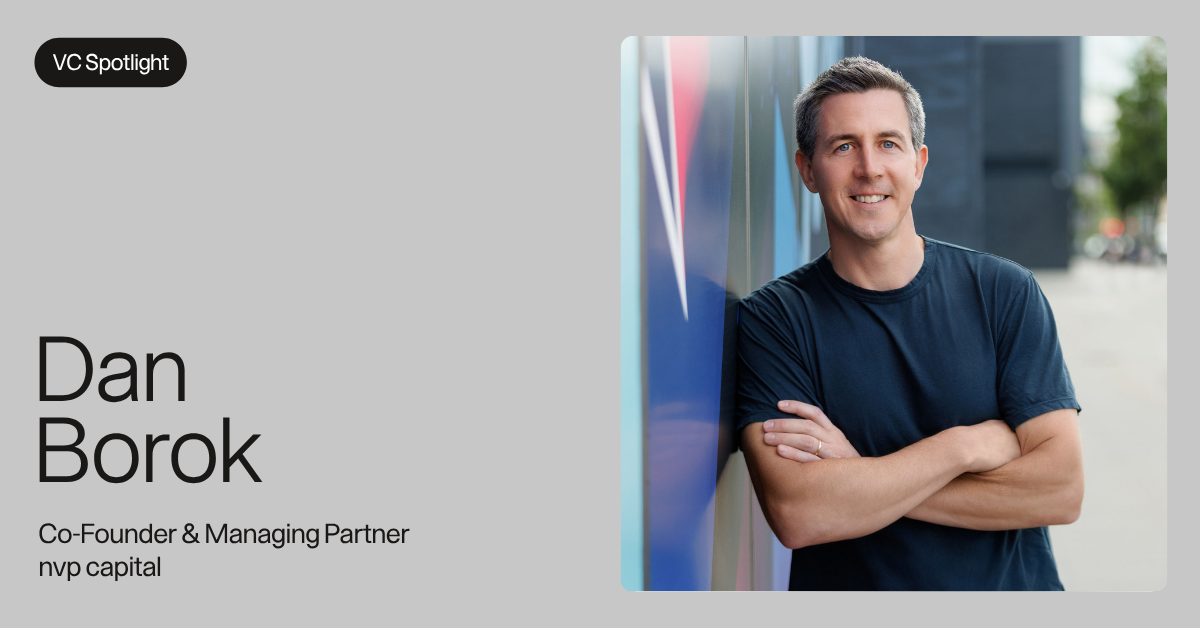
VC Spotlight: Dan Borok, Co-Founder and Managing Partner, nvp capital
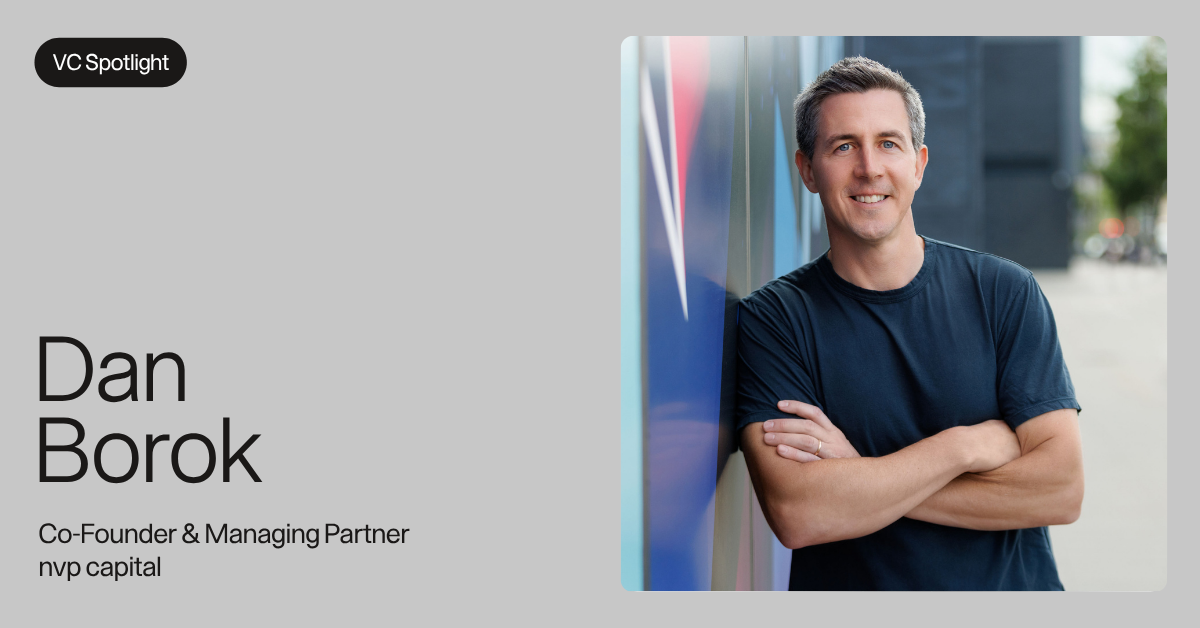
Dan Borok believes the next generation of category-defining companies will be built by founders tackling some of the economy’s most stubborn — and important — problems.
As Co-Founder and Managing Partner of nvp capital, Dan backs early-stage companies transforming mission-critical industries where complex workflows still depend on manual processes or decades-old software.
“We believe that founders who are building companies to address these mission-critical opportunities have a different gear and motivation,” Dan told us. “Plus, these are important challenges with big rewards for getting solved.”
And when it comes to building those companies, Dan sees New York as uniquely positioned to lead.
“New York’s advantage is that the customers are here,” he said. From financial services and healthcare to retail, media, and real estate, the city gives founders the opportunity to build alongside the industries — and buyers — they hope to transform.
We caught up with Dan to discuss his career, the rise of vertical and physical AI, what separates category-defining companies from the pack, the most common mistakes founders make when pitching investors, and much more.
–
Where did your career start?
Dan: My early time at Google had a really big impact on my career. Two things happened there: I saw firsthand how much value creation can happen at a venture-backed private company with the right people and mission, and I also saw how transformative high-quality operations and software can be for a growth-stage company.
That combination set me on a path to venture investing. I left Google for business school to transition into investing. Which I did, joining Millennium Technology Value Partners, a later-stage venture firm, where I led investments in companies like BigCommerce, Magnite, and Envivio, all of which went public, as well as Yodle and Janrain, which were acquired.
In 2020, I co-founded nvp capital alongside my friend and partner Vaughn Crowe to focus on what we are most passionate about: backing founders at the earliest stages who are building companies transforming mission critical industries.
You focus on companies in mission critical industries. What makes a market especially well suited for you, and what signals tell you the timing is right?
We look for markets that are critical, digitally underserved, and on the verge of a structural shift. The best vertical opportunities tend to share a few characteristics: the industry runs on complex, high-volume workflows that are still handled manually or on decades-old software; the domain knowledge required is deep enough that horizontal tools can’t simply be dropped in; and there’s proprietary data or workflow context that a focused company can capture and compound.
We want to invest in industries that are mission critical for the U.S economy — and while that sounds like a broad lens it is a great abiding principle for us. We believe that founders who are building companies to address these mission critical opportunities have a different gear and motivation. Plus, these are important challenges with big rewards for getting solved.
But there are many mission critical challenges that aren’t going to be solved on our investing timeline, or where the ROI doesn’t make sense. So on timing or the ‘why now’ question, we pay close attention to structural signals, like regulatory change, labor shortages, cost pressure, or a technology unlock that suddenly makes a previously impossible workflow automatable. Our nvp galaxy, which includes 35+ corporate limited partners, is a real advantage here: our corporate partners share insider insights on marketplace trends, so we often see demand shifts from the buyer's side before they show up anywhere else.
What stage do you typically invest at and what’s your average check size?
We lead or co-lead pre-seed and seed rounds. Our initial checks are typically between $1.5-4 million, and we reserve capital to follow on in our best companies.
How has your role as an investor changed as you’ve moved from a partner at an established firm to building your own firm?
At an established late stage firm, my job was primarily to find and lead great investments, and work with companies. Building nvp capital with Vaughn, the job became much bigger: you’re not just picking companies, you’re building a firm. That includes setting strategy, raising capital and building a team. I think the biggest (and best) difference is the continuity that comes with building a firm — both for our founder and limited partner relationships.
The weight of responsibility changes too. Our LPs have entrusted us with their capital, and generating strong returns for them is the foundation everything else rests on. As founders of the firm, that responsibility sits squarely with Vaughn and me — it sharpens every decision we make and keeps us disciplined about where we spend our time and capital. Great returns are what earn us the right to keep backing founders, fund after fund.
The other big change is proximity to founders. At the pre-seed and seed stage, we’re often the first institutional capital in, so the work is much more hands-on: opening doors to enterprise buyers, helping with early hires, being a true partner through the messy early days. It's harder, and it's far more rewarding.
New York has strengths in industries like finance, real estate, healthcare, media, and manufacturing. Where do you see the biggest opportunities for New York to become a center for vertical AI innovation?
I have to start by saying I’m a native New Yorker, born and raised in the West Village, so I’ll admit I’m biased. I’ve watched this city reinvent itself over and over, and I love watching it happen again with AI. Now, we invest nationally and have an office in San Francisco, so I see both coasts up close, and that perspective has only strengthened my conviction that New York has something no other city can match when it comes to vertical AI.
New York’s advantage is that the customers are here. Vertical AI is won by founders who deeply understand an industry’s workflows, and in New York you can walk to your buyer. Financial services is the obvious one: the density of banks, insurers, and asset managers makes it the best place in the world to build AI for compliance, risk, and back-office operations. It’s why we backed Compyl, which is building a unified GRC platform right here for exactly that buyer. Healthcare is another huge one: an enormous industry drowning in administrative and financial complexity, which is where a company like Arrow, tackling healthcare finance, comes in. And retail and commerce: this is the retail capital of the world, and Hetal Retail is using AI to make sure brands’ products are in the right stores, on the right shelves, at the right time. Media and real estate follow the same logic: massive legacy industries headquartered here with acute cost and labor pressures.
I’d also add that while the value-creation and growth in SF is incredibly impressive, many of the hyperscalers are now building out big offices in New York as a second HQ. That’s the same path that Google, Meta, Amazon, and others took previously, and it adds to the idea generation and community in New York.
You’ve backed companies from the early stages through IPOs and acquisitions. What qualities tend to show up early in businesses that ultimately become category-defining companies?
A few things show up remarkably early. First, founders with an unfair insight into their market (usually earned through lived experience) paired with the ability to recruit people better than themselves.
Second, evidence that the product is becoming embedded in the customer’s workflow: category-defining companies don’t just get bought, they become hard to rip out.
Third, capital efficiency and commercial instinct from day one, the best founders treat early customers as design partners and close them personally.
And finally, market inflection — you can have a great founder with a strong product solving a real problem that doesn’t pop, because the market inflection or pull isn’t there. I think many of the biggest outcomes align a great founder with an innovation cycle.
What’s the most common mistake you see founders make when pitching to investors?
Leading with the technology instead of the personal story and mission connection. Especially in AI and robotics right now, the technology is super impressive and founders rightly so are proud of their idea or early build. But what I really care about is who they are and how connected they are to specific industry pain-point. The best pitches make me feel the industry’s pain first and present the technology as the inevitable answer.
A close second: not knowing the buyer. In B2B selling, “who signs the contract, and why now?” is the whole game; founders who can’t answer that crisply haven't spent enough time with customers yet.
What’s an investment from the last 12 months you’re especially excited about?
Physical AI has been a big focus for us over the past two years. We think it’s in a bit of a ‘Chat GPT’ moment: better hardware, cheaper sensors, and increasingly capable foundation models are finally converging. That’s why we’re excited about our investments in Vulcan Elements, Reaxiomatic, Haptica Robotics, Outlast Power and Human Archive, among others: each attacks a different layer of the physical AI stack, from the materials foundation to defense aviation to the sensorimotor data that robots will be trained on. The through line is the same as everything we do: founders with earned domain expertise transforming mission critical industries. The difference is the workflows are now physical, not just digital. That’s the frontier, and we are excited about the businesses we see scaling there.
What’s in your tech stack? What's your favorite AI tool?
I’d have to say it’s the tool we just built to score founders — it doesn’t have a name yet, but probably needs one!
What are some of the top resources you recommend for founders starting out?
Honestly, the best resource is other founders. Nothing replaces talking to people a year or two ahead of you who’ve just navigated what you're about to face. That’s a big reason we built the nvp galaxy the way we did: founders learn fastest from each other and from the corporate partners and operators who've seen these workflows from the inside.
Beyond that, customer discovery — it’s hard, but talking to as many folks in your ideal customer profile as possible. Before you start building and while you’re doing early product work.
And I’d be a bad host if I didn’t mention our own content series, Between Two Quarters, where we have honest conversations with founders and operators about commercialization and what real-world AI adoption actually looks like inside legacy industries.
Rapid fire: You have a founder or LP from out of town. Where are you taking them?
During Knicks season: MSG! If it’s not basketball season, maybe golfing at Liberty National.
What’s the best slice of pizza in NYC?
They don’t sell it by the slice, but I grew up going to John’s on Bleecker Street. Arturo’s on Houston is a close second.