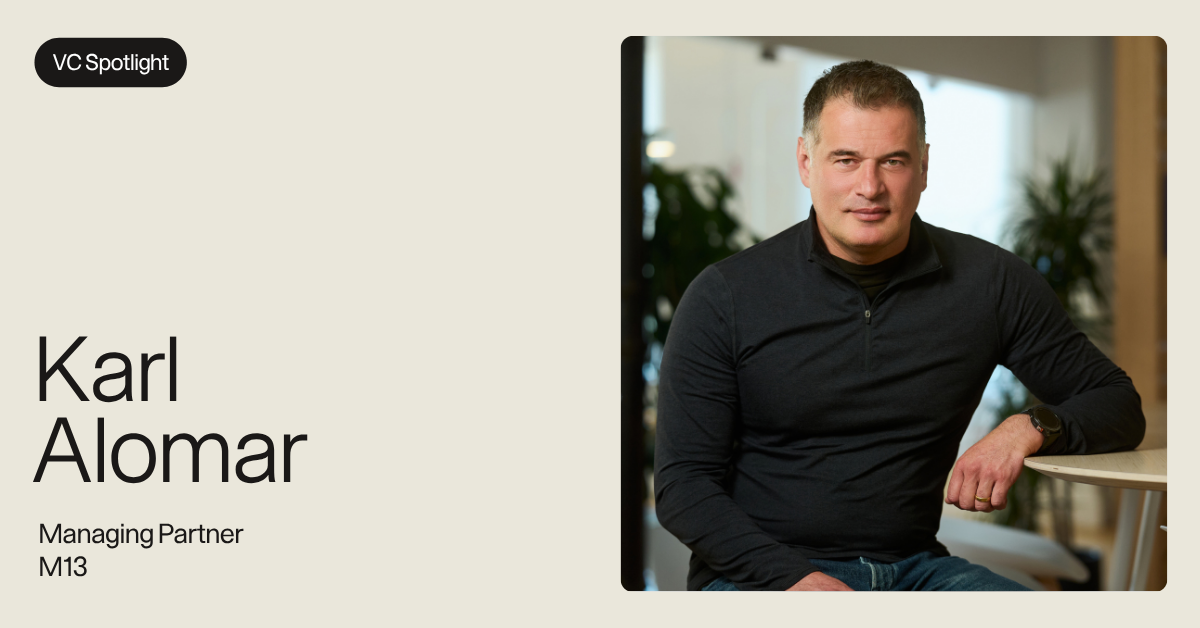
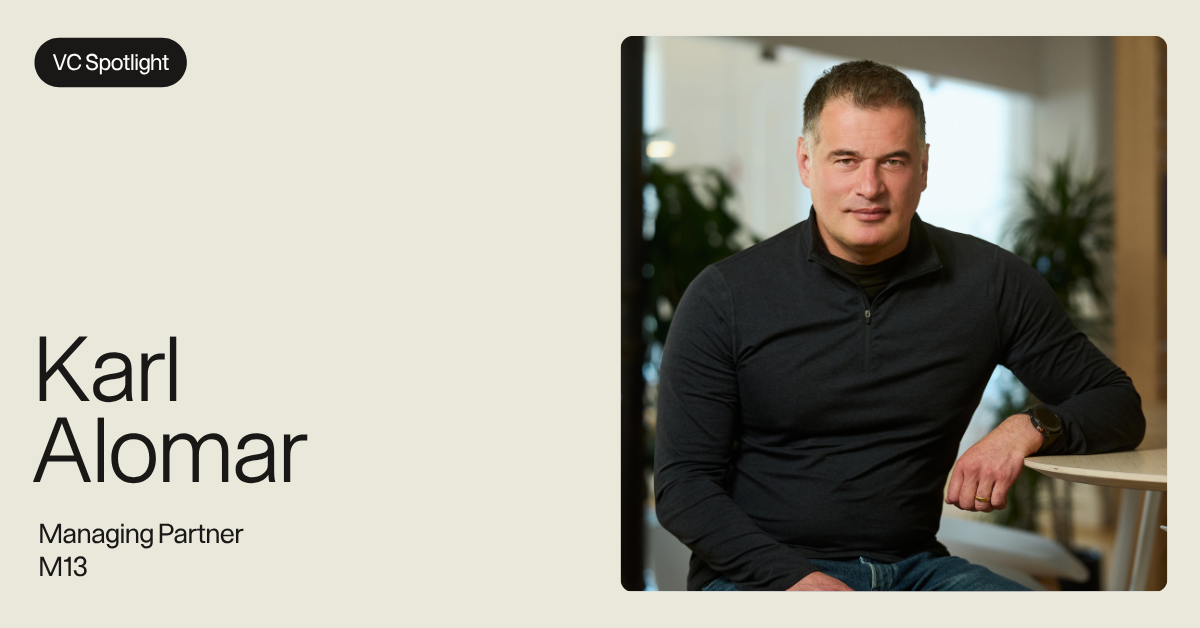
VC Spotlight: Karl Alomar, Managing Partner, M13
Karl Alomar knows what it’s like to sit on both sides of the table.
Before becoming Managing Partner at M13, Karl spent years building and operating technology companies himself. It’s that experience that still shapes how he evaluates founders today.
“Operating is far more nuanced than a balance sheet,” Karl told us. “It requires real empathy for the founder’s journey, where day-to-day decisions ripple across the entire organization.”
At M13, Karl now backs early-stage companies, typically at the Seed and Series A stages, with a particular focus on founders who can turn insight into tangible progress. For him, that often means looking beyond the polished pitch to see how quickly a founder learns, executes, and builds conviction over time.
And increasingly, he’s focused on some of the infrastructure that will underpin the next generation of AI, from making GPUs more efficient to building the verification, identity, and security systems needed for an agentic future.
New York, he says, has a particular advantage in building those kinds of companies. Founders can find deep technical talent and major enterprise customers in the same city, creating faster feedback loops between builders and buyers.
We caught up with Karl to discuss his path from founder to investor, what he looks for before the rest of the market catches on, where the AI stack is still underbuilt, why founders need to truly master their businesses, and much more.
–
Where did your career start?
Karl: My career began as an engineering graduate from Imperial College London. Having moved to California, and after a few years at a large engineering firm, I realized I needed to take control of my own path. So at 24, I co-founded my first technology company with three cofounders. I didn’t fully know what I was doing at the time, but through grit and determination, we rode the wave of the late-'90s California tech boom and built a business that was acquired in 2000. That experience became the foundation for the rest of my career, with key lessons at every stage
You’ve been on nearly every side of the startup world — founder, operator, and now investor. What did running companies teach you about investing that you don’t think you could have learned sitting in venture?
There’s a lot I could point to here — countless variables that I think give an operator an edge as an investor. But if I had to narrow it to one thing, it's this: operating is far more nuanced than a balance sheet. It requires real empathy for the founder’s journey, where day-to-day decisions ripple across the entire organization. Navigating company and people dynamics while aggressively innovating and building a high-growth business is a delicate balancing act — one that can really only be taught through direct experience.
Having lived it changes how you approach both problems and opportunities, and gives you genuine empathy for the choices founders have to make along the way. I’ve heard time and again from founders how valuable it is to have an experienced operator on their cap table or board.
What stage do you typically invest at and what’s your average check size?
At M13, we invest at the earlier stages of the business journey — usually Seed or Series A — with checks typically ranging from $3 million to $15 million. Ideally, we like to see a business that has clearly identified its product and market and achieved early validation within that market. That said, we invest predominantly in great founders and teams, and on that basis, we’ll sometimes go in earlier when we truly believe in the company's vision.
You’ve talked about the danger of getting swept up in other investors’ excitement. When a company is not yet obvious to the rest of the market, what signals give you the confidence to make the bet anyway?
We definitely try to avoid the hype rounds where valuations have gone completely out of control. Rather, I look for evidence that a founder can turn a conversation into progress. Prepared is a good example. I met co-founder Mike Chime in 2020 after speaking at Yale. He walked me to my car and pitched an idea for helping schools respond to emergencies. I understood why the problem mattered, but I didn’t initially see an investable business.
We stayed in touch for about a year. We would discuss what he needed to work through, and the next time we spoke, he had done it. Watching him execute built my conviction. M13 became the company’s first institutional investor, and Axon later acquired it.
That’s what I’m looking for before there’s consensus: a founder who understands the problem, learns quickly and keeps making tangible progress. You can learn a lot more from watching someone build than from a polished pitch.
I’m also looking at the quality of the founder’s team, along with their fit to the category, which we define as Founder Market Fit (FMF). Once we’re confident in the team, we look at the proposed solution and, ideally, early validation — usually shown through early customer demand or deep pipelines, or, for more technical products, through performance results that demonstrate clear differentiation and potential to disrupt the category.
You’ve built and invested in companies across multiple markets. What do you think New York does especially well as a place to build a startup today?
New York puts founders close to the people they’re building for. If you’re selling into banks, media companies or retailers, your buyer is often a subway ride away. That makes it easier to test whether you’re solving a problem someone will actually pay to fix.
New York is also a hub for building technical companies. Two of our portfolio companies are prime examples: Estuary, a data platform that enables enterprises to power analytics, operations, and AI without trading off speed, reliability, or control; and Teleskope, which helps organizations identify and resolve sensitive data exposure. What makes New York particularly compelling to me is having deep technical talent and demanding enterprise customers in the same city.
For international business, New York’s time zone and flight connectivity make it a natural hub, particularly for founders and investors moving between Europe and MENA. And there’s a density effect that’s hard to replicate: the sheer concentration of founders, operators, and investors in one place creates the kind of serendipitous connection and fast feedback loop that's difficult to manufacture anywhere else.
You spend a lot of time on the infrastructure underneath AI applications. What parts of the AI stack do you think are still underbuilt or underappreciated?
There are two key areas within the AI stack that I believe require immediate attention over the coming years.
First, I’ve been clear in the past about the importance of solving the GPU efficiency equation — demand continues to outstrip supply, and major limitations will keep constraining datacenter sprawl, including both structural power limitations and potential political blockers. This leaves us with an optimization problem, and I believe there will be massive breakthroughs that continue to evolve the category through both hardware and software.
The other major gap in the market is agentic security, verification, and identity. A growing number of recent agentic security breaches tell the story of a wild-west agentic world, where identification and enforcement are limited at best. If an agent arrives at a checkout or tries to open a business account, who sent it? What authority does it have? Can the business receiving that request verify the answer? I think those controls become essential as we delegate more transactions to software. This becomes increasingly important as agentic payments become more widespread.
What’s the most common mistake you see founders make when pitching to investors?
There are so many small mistakes founders can make, but ultimately the investor is assessing the caliber of the founder as much as the business story and its potential. The little things really drive this assessment, so here are a couple of things founders should be prepared for.
Founders must be prepared: practice your pitch and anticipate the questions investors are likely to ask. Don’t recite prewritten answers — speak from genuine understanding and knowledge, so both your personality and your mastery of the category come through. Pre-rehearsed pitches rarely feel genuine, so even though preparation matters, the presentation itself should feel natural. Remember, the investor isn’t just assessing this round — they’re assessing your ability to raise future ones.
For me personally, I also expect founders to deeply understand the dynamics and economics of their business: where the product needs to go, how to get there, and how the economics evolve over time. Founders who sell the ‘now’ without a clear perspective on where they’re going are often a red flag. Founders should also be clear about what they need to get there — including resource and knowledge gaps, as well as capital needs. That, again, comes back to founders needing to truly master their business.
What’s an investment from the last 12 months you’re especially excited about? What’s in your tech stack? And what's your favorite AI tool?
I’ll highlight two investments, one for each of the areas outlined above: Baselayer is an agentic verification platform, starting with KYA (Know Your Agent) and agentic payment verification. Makora is a GPU optimization and deployment platform that optimizes the deployment of any workload, on any model, onto any GPU — extracting orders-of-magnitude better performance out of existing hardware.
My tech stack is centered mainly around Claude, since we’ve built a lot of our own AI tooling on top of it to manage how we invest and support our companies. I use Claude broadly in my day-to-day as well, but the tooling we’ve built adds a lot on top of that. That said, there are two other tools I've really enjoyed: Type, a multi-user, collaborative agent-management platform we’ve set up to run a lot of our core agentic workflows at the firm; and my favorite tool of late, Town — a business assistant that keeps impressing me with its timeliness, insight, and context.
What are some of the top resources you recommend for founders starting out?
There’s no shortage of resources out there, but a few stand out to me. On the community side, I always point founders to YC’s Startup School and its library of essays — even outside the program, it’s some of the best operational thinking available for free.
For go-to-market and customer discovery specifically, ‘The Mom Test’ by Rob Fitzpatrick is close to required reading; it changes how you think about talking to customers before you’ve built anything.
But if I'm honest, the single highest-leverage resource isn’t a book or a course — it’s other people. Building relationships with a handful of experienced operators or founders a stage or two ahead of you tends to beat any written resource, because the advice is timely and specific to the exact problem you’re facing, not generic. That’s also part of why having an investor who’s actually operated before — who’s sat in your seat — can compress a lot of that learning curve rather than just writing a check.
Rapid fire: You have a founder or LP from out of town. Where are you taking them?
For an LP: Crane Club — it is perhaps a little fancy, but, as a members club with phenomenal food, I believe it makes guests feel special while remaining casual and comfortable enough in a private setting to help make a real connection.
For a founder: maybe the carousel on the water in DUMBO, really just to see how they react… then Crane Club.
What’s the best slice of pizza in NYC?
For pizza — Lucali, in Brooklyn.