

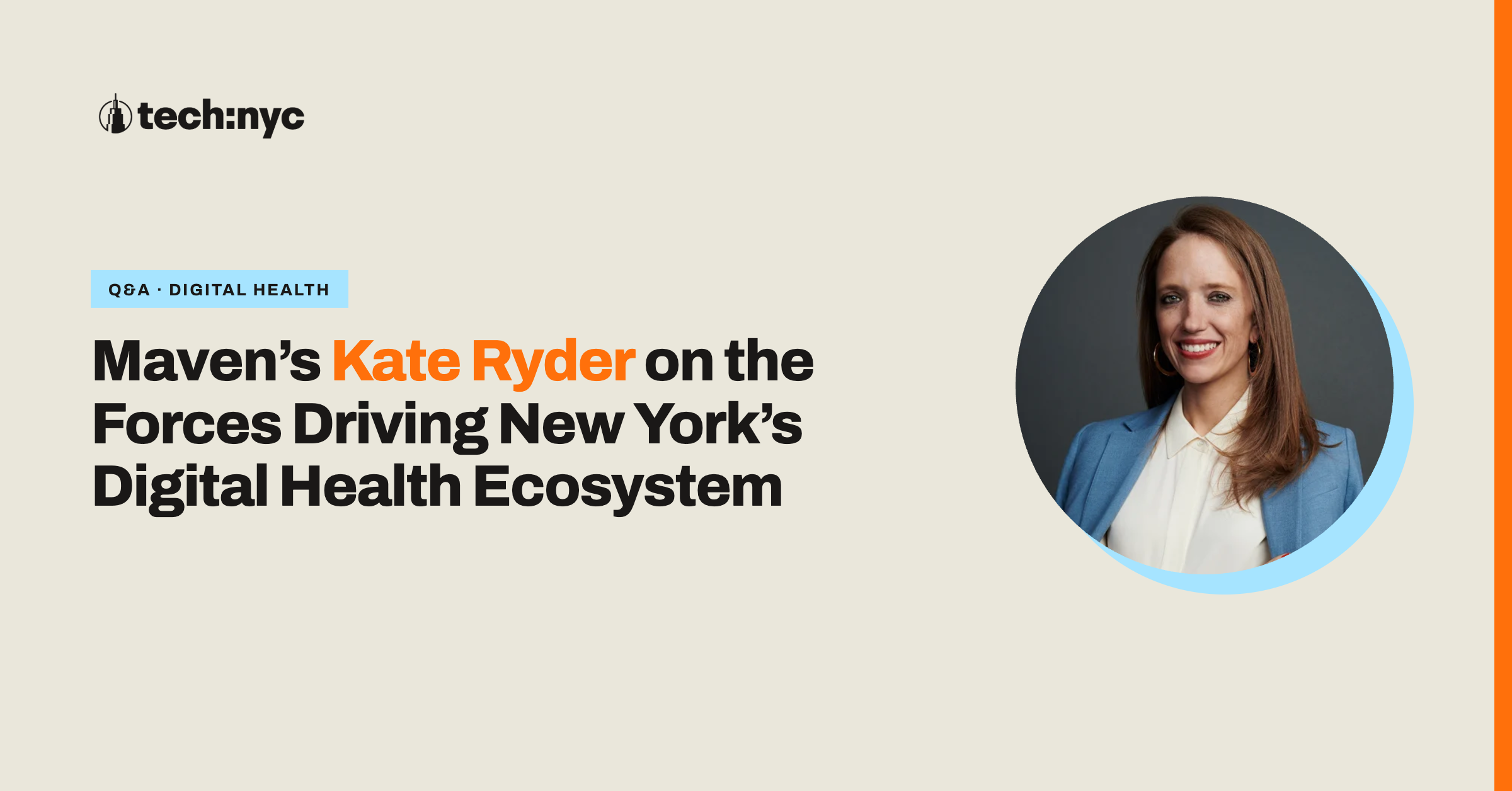
Maven’s Kate Ryder on the Forces Driving New York’s Digital Health Ecosystem
New York healthcare companies raised $1.2 billion across 40 deals in the second quarter of 2026, another sign of the city’s staying power as a hub for healthcare innovation.
But funding figures only tell part of the story. What makes New York a particularly fertile place to build a digital health company?
For Kate Ryder, founder and CEO of Maven Clinic (and a board member of Tech:NYC), part of the answer has little to do with healthcare itself.
“New York doesn't let you get comfortable,” Kate told Tech:NYC. “There's too much competition to build something mediocre. If you're not good, someone in this city will out-build you within a year.”
Kate founded Maven in New York more than a decade ago. Since then, the company has grown into one of the city’s most prominent digital health businesses, while New York’s broader healthcare startup ecosystem has matured around it.
What Kate sees as uniquely valuable about the city is the collision of industries that happens here. Healthcare companies are competing with other healthcare companies for talent or consumers’ attention, and they’re surrounded by some of the best companies in finance, media, technology, fashion and consumer brands.
“The people who work in health tech here could just as easily be at a bank or a magazine or a hospital — they have options,” Kate said.
That competition can raise the bar for the products healthcare companies build, too.
Walk outside Maven’s SoHo offices, Kate said, and companies are surrounded by examples of sophisticated branding and consumer experiences. For an industry that has historically struggled to build products consumers genuinely want to use, she argues that proximity matters.
“We’re not just trying to build an outstanding member experience by healthcare standards, which are low,” she said. “We’re trying to build to reach the standards of the brands we see on Broadway.”
“If you’re not good, someone in this city will out-build you within a year.”
A more connected ecosystem
The city’s digital health ecosystem has changed significantly since Maven launched in 2014.
Back then, Kate said, New York already had the necessary ingredients: clinicians, investors and technologists were all here. The problem was that they largely operated in separate worlds.
“I could find those people easily in New York in 2014, but none of them talked to each other,” she said.
Today, those lines are much blurrier.
It is increasingly common, she said, to encounter startup founders with experience spanning medicine and product, or people inside major health systems who approach problems with the mindset of a technology entrepreneur.
“The worlds of clinicians, investors, and technologists crossover much more naturally,” Kate said. “That overlap didn’t exist in the same way when we started.”
There’s another sign of how much things have changed. Kate rarely has to explain anymore why a technology company would choose to build its headquarters in New York.
“A decade ago I definitely did,” she said.
The next test
The maturation of New York’s digital health sector is happening alongside another shift. Nearly every healthcare company is now considering how artificial intelligence fits into its product and operations.
Maven is among them. The company recently launched Maven Intelligence, an AI layer designed to use data across areas including fertility, pregnancy, parenting, and menopause to help its care teams identify information that could otherwise be missed.
For Kate, the central question is not whether AI belongs in healthcare, but rather where.
“The risk isn’t that AI erodes trust — it's that companies use it to replace relationships instead of strengthening them,” she said.
Maven’s approach is to put AI behind its care team rather than between patients and their providers. The technology can surface a signal, but that signal ultimately goes to a person.
“If AI in this space is going to earn trust, it has to make the human relationship even better — more informed, more attentive, more oriented to what patients want — not less necessary,” she said.
It’s a philosophy that also reflects Ryder’s broader argument about building healthcare technology in New York.
The opportunity is to combine the city’s clinicians and health systems with the talent, product thinking, and consumer expectations found across its other industries — and build to a much higher bar.